A website is more than an online brochure. It is often the first place potential customers encounter your brand, learn about your services, compare their options, and decide whether to contact you.
However, simply having a website does not guarantee results.
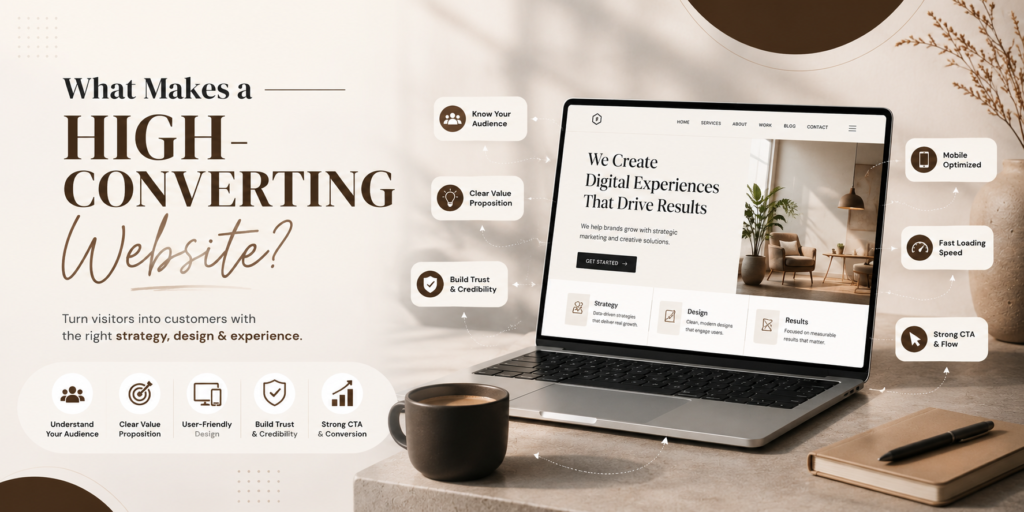
A high-converting website is designed to guide visitors toward a specific action, such as making a purchase, submitting an inquiry, booking a consultation, requesting a quote, or contacting your business.
So, what makes a website turn visitors into customers?
The answer lies in a combination of user experience, persuasive content, trust, technical performance, SEO, and well-placed calls to action.
This guide explores the key features every business website needs to attract visitors, build credibility, and increase conversions.
What Is a High-Converting Website?
A high-converting website encourages visitors to complete a desired action.
Depending on the business, this could include:
- Filling out a contact form
- Calling the business
- Booking an appointment
- Purchasing a product or service
- Requesting a quotation
- Signing up for a newsletter
- Starting a conversation through WhatsApp
Conversion does not always mean an immediate sale. For service-based businesses, generating a qualified lead can be equally valuable.
The most effective websites are built around clear business goals and user needs, rather than visual appeal alone.
Website conversion is crucial for businesses.
Attracting visitors to your site is just the beginning.
Consider this: if 1,000 individuals visit your website monthly but very few reach out or make a purchase, then mere traffic isn’t yielding significant business outcomes.
A website designed with conversion in mind can transform visitors into valuable business prospects.
An effectively organized website can:
- Generate quality leads
- Boost inquiries and bookings
- Foster customer trust
- Enhance your online visibility
- Aid digital marketing efforts
- Increase advertising effectiveness
- Clarify your services for potential clients.
Your website should therefore support the entire customer journey, from discovering your business to taking action.
Ten Essential Elements of a Website That Converts Well
1. A Clear and Compelling Value Proposition
Visitors should understand what your business offers within a few seconds of landing on your website.
Your homepage should clearly communicate:
What do you offer? Who do you help? Why should customers choose you?
Avoid vague headlines such as
“Welcome to Our Website”
Instead, communicate the specific value you provide.
For example:
“Digital Marketing Solutions That Help UAE Businesses Grow Online”
A strong value proposition immediately gives visitors a reason to continue exploring your website.
2. Simple and User-Friendly Website Navigation
Good navigation makes it easy for visitors to find the information they need.
Your main navigation might include:
- Home
- About
- Services
- Portfolio
- Blog
- Testimonials
- Contact
Avoid overwhelming visitors with too many menu options.
Visitors should be able to understand what you offer and find your contact information without navigating through several unnecessary pages.
Effective web development in Sharjah should focus not only on technical functionality but also on creating a smooth and logical user experience.
3. Strong and Relevant Calls to Action
A visitor may be interested in your service but still leave if you do not clearly explain what they should do next.
This is where calls to action (CTAs) become important.
Examples include:
- Get a Free Consultation
- Request a Quote
- Book a Call
- Contact Us
- Start Your Project
- Get Started
Your CTA should match the user’s stage in the buying journey.
For example, someone reading an introductory blog post may not be prepared to buy. A gentler CTA like “Talk to an Expert” might be better.
4. Mobile-Friendly and Responsive Design
A significant amount of website traffic comes from mobile devices. Your website should therefore work properly across smartphones, tablets, laptops, and desktops.
A responsive website automatically adapts to different screen sizes.
Make sure:
- The text is easy to read.
- Buttons are easy to tap.
- Images display correctly.
- Forms work properly.
- Navigation is simple.
- Important information is visible.
- Pages load efficiently.
A poor mobile experience can quickly drive visitors away, regardless of how attractive the desktop version looks.
5. Fast Website Loading Speed
Website performance affects user experience to a great extent.
If a page takes too long to load, visitors may leave before seeing your content or services.
Businesses can improve performance by:
- Compressing large images
- Using modern image formats
- Reducing unnecessary plugins
- Optimizing CSS and JavaScript
- Choosing reliable hosting
- Implementing browser caching
- Removing unnecessary website elements
Speed should be considered during website development rather than treated as an afterthought.
6. High-Quality, Customer-Focused Content
Your content should answer the questions potential customers actually have.
Instead of simply describing your business, focus on your customers’ problems, goals, concerns, and desired outcomes.
For example, instead of:
“We provide SEO services.”
You could write:
“Increase the visibility of your website and draw in prospective clients who are actively looking for your services.”
This approach makes your content more useful and persuasive.
A content marketing expert understands that effective content is not simply about inserting keywords. It is about providing genuine value while naturally guiding users toward the next step.
7. Trust Signals and Social Proof
People are more likely to contact a business when they trust it.
Your website should provide evidence that your business is credible.
Useful trust signals include:
- Customer testimonials
- Google reviews
- Case studies
- Client logos
- Certifications
- Awards
- Portfolio examples
- Professional experience
- Results and achievements
- Clear contact information
Testimonials and case studies can reduce uncertainty and help potential customers feel more confident about contacting your business.
Instead of simply claiming that your service is good, show evidence of the value you provide.
8. Professional Design That Builds Credibility
An attractive website can create a strong first impression, but design should serve a clear purpose.
A professional website should include:
- Consistent branding
- Clear typography
- Appropriate whitespace
- High-quality visuals
- Consistent colors
- Easy-to-understand layouts
- Strong visual hierarchy
Avoid excessive animations, pop-ups, colors, or decorative elements simply because they look impressive.
Every design element should contribute to usability, communication, or conversion.
The goal is not to make your website complicated. It is to make it easy for visitors to understand your business and take action.
9. SEO-Friendly Website Structure
A high-converting website also needs to be discoverable.
Search engine optimization helps potential customers find your website when they search for relevant products, services, or solutions.
Important SEO elements include:
- Keyword-focused page titles
- Optimized meta descriptions
- Proper heading structure
- Search-friendly URLs
- Internal linking
- Optimized images
- Useful and original content
- Mobile responsiveness
- Fast loading speed
- Structured data where appropriate
However, SEO should never come at the expense of readability.
Keywords should be incorporated naturally while keeping the content useful for real people.
10. Easy-to-Use Contact and Lead Forms
If your website is designed to generate leads, the contact process should be simple.
A complicated form with too many fields can discourage visitors from completing it.
Ask only for information you genuinely need, such as
- Name
- Phone number
- Service required
- Brief project details
You can also provide alternative contact methods such as phone, email, or WhatsApp.
The easier it is for customers to contact you, the fewer barriers stand between interest and conversion.
E-E-A-T: Why Experience and Trust Matter
Google’s E-E-A-T framework stands for:
Experience, Expertise, Authoritativeness, and Trustworthiness.
These principles are important for creating useful business content and establishing credibility online.
Experience
Demonstrate real-world experience through:
- Case studies
- Project examples
- Personal insights
- Client experiences
- Practical recommendations
- Results
Real experience makes content more useful and believable.
Expertise
Show that you understand your subject.
Well-researched articles, detailed service pages, useful guides, and accurate information can demonstrate expertise.
Businesses should avoid unsupported claims and keep important information accurate and up to date.
Authoritativeness
Authority develops when customers, industry professionals, and other organizations recognize your expertise.
This can be supported through:
- Quality backlinks
- Industry mentions
- Professional credentials
- Reviews
- Partnerships
- Publications
- Demonstrated expertise
Trustworthiness
Trust is one of the most important elements of conversion.
Make your website transparent by providing:
- Accurate business information
- Clear contact details
- Privacy information
- Secure browsing
- Genuine reviews
- Transparent service information
Visitors should feel confident that they are dealing with a legitimate and reliable business.
How to Improve Website Conversion Rates
Building a high-converting website is not a one-time task.
Once your website is live, monitor how users interact with it and identify areas for improvement.
Important metrics include:
Conversion Rate
Measures the percentage of visitors who complete a desired action.
Form Submissions
Shows how many visitors become potential leads.
Click-Through Rate
Measures how effectively links and CTAs encourage users to take the next step.
Traffic Sources
Shows where visitors come from, including search engines, social media, advertisements, and referrals.
This data can help you identify pages that attract visitors but fail to convert them.
Common Website Mistakes That Reduce Conversions
Even attractive websites can struggle to generate results when they contain conversion barriers.
Common mistakes include:
Too Much Information
Large blocks of text without headings, bullet points, or visual breaks can make content difficult to consume.
Weak CTAs
If users cannot identify the next step, they may simply leave.
Poor Mobile Experience
A website that works well on desktop but poorly on mobile can lose valuable visitors.
Slow Loading Pages
Slow websites can create frustration and negatively affect user experience.
Lack of Trust Signals
Visitors may hesitate to contact a business if there are no reviews, testimonials, case studies, or portfolio examples.
Unclear Service Information
Potential customers need to understand what you offer, who it is for, and how it can help them.How Web Design and Digital Marketing Work Together
Your website should not operate independently from your marketing strategy.
For instance, a client may learn about your company through:
Google Search → Website → Service Page → Testimonial → Contact Form → Lead
Another customer might come through:
Social Media → Landing Page → Service Information → CTA → Enquiry
Your website acts as a central destination where different marketing channels can turn attention into action.
This is why businesses investing in SEO, social media marketing, Google Ads, or content marketing should also focus on website conversion optimization.
A strong marketing campaign can bring visitors to your website, but if the website is confusing or difficult to use, those visitors may never become customers.
Website Conversion Checklist
Before launching or redesigning your business website, ask:
Is the primary value proposition readily apparent?
- Can visitors easily understand our services?
- Is the website mobile-friendly?
- Does every important page have a clear CTA?
- Are contact details easy to find?
- Does the website load quickly?
- Are customer reviews visible?
- Does the content answer customer questions?
- Is the website designed to be search engine friendly?
- Does the design communicate professionalism?
- Are forms simple to complete?
- Can we measure conversions and user behavior?
- Does the website demonstrate experience and expertise?
If the answer to most of these questions is yes, your website is already moving in the right direction.
Conclusion
A high-converting website is not simply a beautiful website.
It is a strategic business asset designed around users, trust, search visibility, performance, and measurable business goals.
From a clear value proposition and mobile-friendly design to strong CTAs, useful content, social proof, SEO, and simple contact forms, every element should make it easier for visitors to move from interest to action.
Whether you are launching a new business website or improving an existing one, ask yourself:
“Does this website make it easy for my ideal customer to understand, trust, and choose my business?”
When the answer is yes, your website becomes more than an online presence. It becomes a powerful part of your marketing and sales process.
Frequently Asked Questions
1. What makes a website high-converting?
A high-converting website combines clear messaging, easy navigation, strong calls to action, mobile-friendly design, fast loading speed, trustworthy content, and simple contact options. These elements help visitors understand the business and encourage them to take the desired action.
2. How can I improve my website’s conversion rate?
You can improve conversions by simplifying navigation, strengthening your CTAs, optimizing pages for mobile devices, improving loading speed, adding customer reviews and testimonials, creating useful content, and making contact or enquiry forms easy to complete. Working with a Digital Marketing Expert in Sharjah can also help you analyze website performance, understand user behavior, and identify opportunities to improve conversions. Regularly reviewing website analytics can further help identify areas that need improvement.
References
- Absolute Websites. Business Websites – Web Design.
Absolute Websites – Business Websites - Zoho Sites. High-Converting Website Structure.
Zoho Sites – High-Converting Website Structure