AI is altering the way people search for information, discover products, and decide to make purchases. Since AI assistants are now included in everyday digital experiences, businesses and marketers have become more focused on a new question: What occurs when advertising is incorporated into AI-driven conversations?
The inclusion of advertisements in ChatGPT marks a significant development in the field of digital advertising; rather than depending merely on standard search results, users are now able to come across information via conversational interactions.
This opens up interesting possibilities for businesses concerning visibility, advertising strategy, user intent, and the customer journey.
In this blog article we will look at what the ads in ChatGPT mean, examine how they might affect digital marketing, and consider what businesses should take into account as AI continues to have an impact on online discovery.
What are ads in ChatGPT?
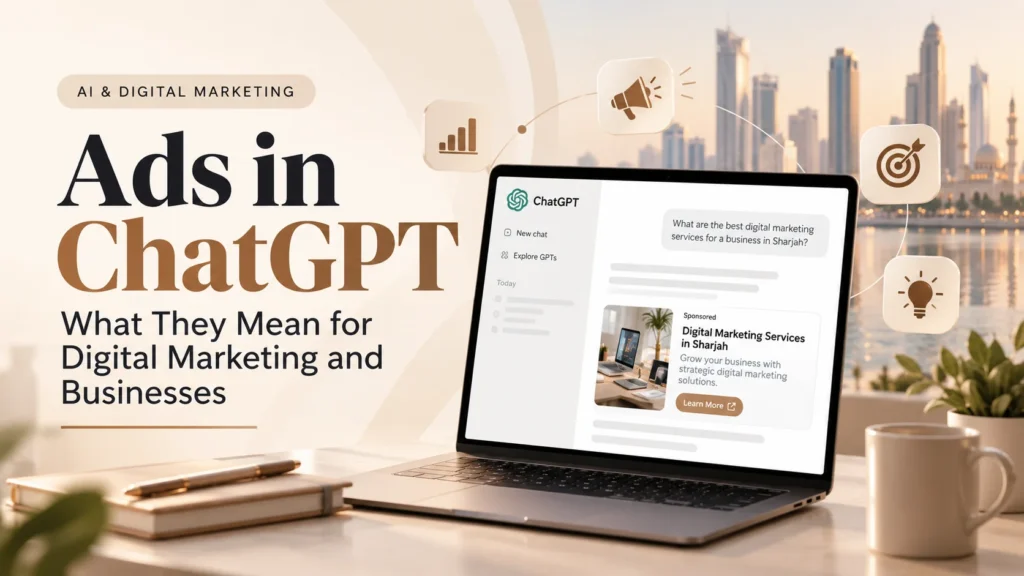
The advertisements in ChatGPT are sponsored advertising experiences that can appear within the ChatGPT environment.
In the case of traditional search advertising, sponsored results are shown together with organic search results; with AI-based advertising, however, the user experience is based on a conversation.
For instance, a user could inquire of an AI assistant:
What would be some good ideas for improving my business website?
Rather than just getting a list of search results, the user could be given a conversational answer, and advertising in this setting might offer the user relevant sponsored products or services during their interaction.
The format, availability, targeting features, and qualification criteria for ChatGPT advertising may change as the platform evolves, so companies should keep an eye on official announcements rather than suppose that AI advertising functions in the same way as Google Ads or Meta Ads.
Why are the ads that appear in ChatGPT important for digital marketing?
The most significant change isn’t just the location in which an advertisement appears. It is the kind of user journey associated with it.
Traditional advertising usually begins with an ad impression and then tries to generate interest.
An AI-assisted discovery process can start with a question, a problem, or an intention.
This creates an interesting relationship between:
- User intent
- Conversational search
- Content discovery
- Paid advertising
- Brand visibility
- Customer decision-making
Since consumers are becoming more at ease in asking AI tools for advice and information, marketers should consider going beyond conventional keyword targeting.
From Keywords to Intent
In the past, search marketing has always placed a great deal of importance on keywords.
AI-powered experiences place a greater focus on understanding the meaning behind a question.
Consider the difference between:
Traditional search:
“best website developer in Sharjah”
Conversational query:
I operate a small business in Sharjah and would like a website that is able to produce inquiries. What features should I look for?
The second question gives a lot more context.
What this indicates is that marketers should give more thought to the problems that customers are trying to solve rather than concentrating only on individual keywords.
How might advertisements for ChatGPT affect businesses?
The extent of the impact will vary according to the way advertising products evolve and the way users interact with them.
There are, however, a number of areas that deserve attention.
1. New chances to gain brand visibility
Businesses are always seeking out ways to contact potential customers at the right times.
If AI advertising is to become yet another digital advertising channel, companies might one day have another chance to be seen when users are researching products, services, or solutions.
This could increase the significance of grasping digital visibility for small businesses.
2. A greater focus on user intent
A conversation usually gives more context than a short search query.
This could encourage advertisers to think about different stages of the customer journey, such as
- Awareness
- Problem identification
- Research
- Comparison
- Consideration
- Purchase
An effective advertising strategy should focus on the needs that the user really has at each stage rather than seeing every interaction as a chance to make a sale.
Changes to the Customer Journey
The traditional customer journey might look something like this:
Inquiry → Advertisement → Site → Offering → Outcome
An AI-assisted journey could potentially become:
Question → AI conversation → Discovery → Consideration → Website or conversion
It doesn’t indicate that traditional channels will vanish; on the contrary, AI could act as an additional layer within the entire customer journey.
What action should businesses take in order to get ready?
It is not necessary for businesses to alter their whole marketing strategy right away due to AI advertising.
They can instead begin to reinforce the fundamentals.
Create Helpful, Original Content
AI systems depend on information in order to understand businesses, products, and topics.
Businesses should therefore maintain useful website content that clearly explains:
- What they offer
- Who they serve
- Where they operate
- What makes their offering different?
- Frequently asked customer questions
- Relevant expertise and experience
Good content can help people find you on many online platforms.
Build a Strong Website
Your website remains a crucial element of your online identity.
Make sure your website has:
- Clear service pages
- Easy navigation
- Accurate business information
- Strong calls to action
- Mobile-friendly design
- Fast loading times
- Trust signals
- Relevant and useful content
Even though AI might introduce users to a business, the website can still be important in turning interest into action.
Strengthen Your Online Presence
Consistent information should also be kept by businesses across the relevant platforms.
This can include:
- Google Business Profile
- Social media profiles
- Business directories
- Professional websites
- Industry platforms
- Customer reviews
Giving people and digital systems consistent information makes it easier for them to understand a business.
What does this mean for those who work in digital marketing?
For marketers, gaining deeper insights into the digital customer journey provides yet another incentive to adopt AI advertising.
A performance marketing specialist might have to go beyond the individual advertising platforms and take into account how paid media, organic search, content, websites, analytics, and AI-powered discovery function together.
Instead of asking only:
“How many people saw my ad?”
Marketers increasingly need to consider questions such as
- What specific problem was the customer attempting to solve?
- What was the basis of their decision?
- On which channel was the brand launched?
- What took place following the interaction?
- Did the customer take some significant action?
- What ways are there of improving the experience?
What this method does is to move the emphasis away from individual metrics and towards the entire customer journey.
AI Advertising and Local Businesses in Sharjah
Local businesses have a special kind of opportunity since people generally look for services according to both the need and the location.
For example:
“Best digital marketing company for a small business in Sharjah”
or:
What is the best way of attracting more customers to my business, which is based in Sharjah?
The searches involve combining a problem with a local context.
People who want to target customers in the UAE should therefore make sure they focus on local SEO, useful content, correct business information, customer reviews, and a good website.
If companies are seeking digital marketing services in Sharjah, the increasing importance of AI suggests that possessing a simple online presence is no longer sufficient. They should consider how their brand is presented on search engines, social media platforms, maps, their websites, and other emerging AI-driven discovery services.
Ads in ChatGPT vs. Traditional Digital Advertising
It does not have to be seen as AI advertising replacing the present advertising platforms.
Google Ads, Meta Ads, LinkedIn Ads, and the other various advertising channels have different purposes and target different audiences.
A better way is to understand the strengths of each channel.
|
| Channel | Common Purpose |
| Google Ads | Capture active search intent |
| Meta Ads | Build awareness and reach targeted audiences |
| LinkedIn Ads | Reach professional and B2B audiences |
| SEO | Build long-term organic visibility |
| Content Marketing | Educate and build trust |
| AI-powered discovery | Emerging conversational discovery opportunity |
The combination that works will vary according to the business, the audience, the objectives, the budget, and the customer journey.
E-E-A-T: Why Trust Matters Even More in the AI Era
The greater the amount of information produced by AI, the more important trust becomes.
Google’s E-E-A-T framework focuses on:
- This refers to having direct knowledge or experience in a given situation when appropriate.
- Demonstrating knowledge and a good understanding of the subject.
- Establishing authority by means of high-quality information and a good reputation.
- Giving information that is accurate, transparent, and reliable.
What this means for businesses is that it is not sufficient merely to produce content in order to target keywords.
Instead, content should give real value.
For example, a local business could publish:
- Helpful guides
- Original insights
- Frequently asked questions
- Case studies where genuine data is available
- Author information
- Business experience
- Accurate service information
- References to reliable sources
This establishes a more solid base for long-term digital visibility.
What should marketers look at next?
The field of AI advertising is still developing.
Marketers should pay attention to developments in:
Conversational Search
It is possible that people will start to use AI assistants when carrying out product research, comparing different options, and gaining an understanding of complicated topics.
AI-Powered Recommendations
Recommendations are likely to play an ever-greater role in the way that users find out about brands and products.
Privacy and Personalization
Advertising systems will have to strike a balance between personalization and users’ expectations concerning privacy and transparency.
Measurement
Marketers will need reliable methods of working out whether AI-driven discovery leads to important business results.
Content Strategy
Businesses may need to create content that answers real customer questions rather than producing content
conclusion
The presence of advertisements in ChatGPT signifies a wider shift in the digital marketing environment: the manner in which people find information is changing.
For businesses the chance is not just about getting involved in a different kind of advertising. It is about gaining an understanding of how customers carry out research, ask questions, compare solutions and make decisions in a world that is becoming more and more powered by AI.
Businesses should keep on concentrating on the basics such as useful content, solid websites, accurate information, customer trust, measurable campaigns, and having a clear understanding of their audience.
Since AI advertising is still in its early stages, marketers should stay curious, responsibly test it, and adjust their strategies as new information and advertising formats become available.
The future of digital marketing won’t be about deciding between search, social media, websites, or AI.
It could be concerning how all these experiences come together.
Frequently Asked Questions
- What are the advertisements in ChatGPT?
Ads in ChatGPT are instances of sponsored advertising which can appear in the ChatGPT environment and the format, availability, and features of such ads may change as AI advertising advances.
- Will advertisements for ChatGPT take the place of Google Ads or Meta Ads?
It doesn’t have to. Various advertising platforms have different aims. Google Ads is capable of picking up on search intent, whereas Meta Ads can assist companies in reaching their audiences via social media. AI advertising constitutes yet another possible channel rather than automatically taking the place of the existing platforms.
- What steps can businesses take in order to prepare for advertising that is powered by AI?
A business can begin by producing useful content, ensuring its online presence is accurate, improving its website, enhancing its local SEO, building up trust, and gaining an understanding of customer intent. These basic steps can help with visibility on both traditional and new digital channels.
About the Author
Fathimath Thasni, who is based in Sharjah, UAE, is a person interested in digital marketing and in building her personal brand, with a focus on studying and putting into practice SEO, website development, social media marketing, Google Ads, Meta Ads, content marketing and performance marketing.
With Fathimath, she discusses practical insights into digital marketing, as well as her experiments and learning experiences, for the purpose of benefiting businesses and those who are aspiring to become marketers.