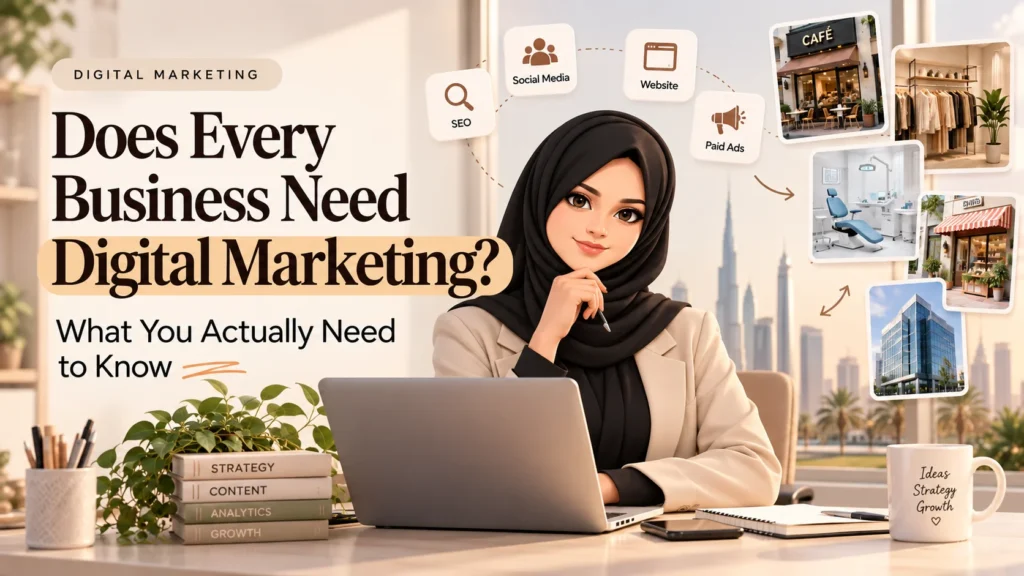
What counts as digital marketing, and is it important for every business?
You have already been exposed to digital marketing if, at any time, you have searched for a product on Google, looked up a business on Instagram, watched an advertisement on YouTube, or opened a promotional email.
But what exactly is digital marketing?
Digital marketing involves promoting a business, a product, or a service by means of digital channels such as search engines, websites, social media, email, online advertising, and other digital platforms.
It is now possible for businesses to become more easily discovered, to communicate with potential customers, and to build up relationships with their audience through an online presence. Yet this does not imply that every business has to make use of every digital marketing channel.
The appropriate method will vary according to the business, its customers, objectives, place, budget, and the industry it is in.
What Is Digital Marketing?
“Digital marketing is a broad term that encompasses a variety of methods that businesses may use to reach customers online.”
Some common areas of digital marketing include
- Search Engine Optimization (SEO)
- Google Business Profile optimization
- Social media marketing
- Content marketing
- Google Ads and other paid advertising
- Email marketing
- Website development and optimization
- Performance marketing
- Online reputation management
- Analytics and conversion tracking
For instance, a local restaurant could concentrate on Google Search, the Google Business Profile, Instagram, and online reviews.
An e-commerce business might place a greater emphasis on SEO, social media, Google Ads, Meta Ads, email marketing, and conversion optimization.
A business-to-business company could give priority to SEO, LinkedIn, content marketing, email marketing, and lead-generation campaigns.
This shows an important point:
The fact is that digital marketing can’t be applied in a one-size-fits-all manner.
Why is digital marketing important for businesses?
More and more people are using digital platforms to find out information, compare different options, get in touch with businesses, and decide on purchases.
It provides businesses with the chance to be there where their potential customers are already spending their time.
1. It allows individuals to discover your business.
Picture a person looking on Google for a business service that you offer.
You have the chance to introduce your business to a potential customer if your website or business profile comes up when they are carrying out a search.
Online visibility can result from SEO, local SEO, Google Business Profile optimization, content, and paid advertising.
2. It helps to build trust.
It is common for customers to carry out some research on a business before they get in touch with it or buy from it.
They may look at:
- Your website
- Google reviews
- Social media profiles
- Photos and videos
- Customer information
- Services and pricing
- Educational content
Having a professional and steady presence online makes it easier for potential customers to understand the nature of your business.
3. It allows companies to focus on particular audience segments.
Traditional advertising has the possibility of reaching a wide audience, whereas a great many digital platforms offer the option of targeting people according to factors such as their location, interests, search behavior, or demographic information.
For instance, a local service business might wish to target people in a particular geographical area rather than attempt to advertise throughout the whole country.
4. Measurement is made easier
A useful feature of digital marketing is the capacity to measure various activities.
Depending on the channel, businesses can track metrics such as
- Website traffic
- Search visibility
- Clicks
- Engagement
- Leads
- Conversions
- Cost per result
- Advertising spend
Such insights can enable businesses to find out what is working and where improvements might be required.
5. It provides long-term visibility.
Not all digital marketing efforts are designed to yield instant outcomes.
For example, developing SEO and content marketing can require time.
Moreover, once published, valuable content can continue to draw visitors through search engines.
This is a reason why businesses should regard digital marketing as an ongoing process rather than as a one-off activity.
Does Every Business Need Digital Marketing?
In most cases businesses can obtain benefits by having some kind of a digital presence.
But there is an important distinction:
Not every business needs every kind of digital marketing.
A business must select its channels in accordance with where its customers are and what it aims to achieve.
For instance, a local plumbing business might not have to spend the majority of its budget on content for Instagram.
Instead, it may benefit more from:
- A professional website
- Google Business Profile optimization
- Local SEO
- Google Search visibility
- Reviews
- Search advertising
On the other hand, a fashion brand may place greater importance on:
- TikTok
- Visual content
- Influencer marketing
- Meta Ads
- E-commerce SEO
- Email marketing
The strategy must be based on the customer journey, not just on the popularity of a platform.
What kinds of businesses should think about using digital marketing?
Digital marketing can be useful across many industries, including
Local Businesses
Examples include:
- Restaurants
- Salons
- Clinics
- Gyms
- Repair services
- Paint shops
- Real estate businesses
- Cleaning companies
- Home service providers
For such businesses, carrying out local SEO, optimizing their Google Business Profile, obtaining reviews, maintaining their websites, and using location-targeted advertising can be very useful.
E-commerce Businesses
Online shops can attract visitors, promote their products, win back potential customers, and encourage customers to make purchases again by using digital marketing.
The usual methods are SEO, Google Ads, Meta Ads, email marketing, content marketing, and conversion optimization.
Professional Service Businesses
Experts such as consultants, agencies, accountants, lawyers, designers, developers, and others can show off their skills and obtain inquiries through the use of digital marketing. All of these things—content marketing, SEO, LinkedIn, websites, email marketing, and paid advertising—can beinvolved.
B2B Businesses
B2B companies can make use of digital marketing in order to create awareness, provide education to potential customers, generate leads, and keep in touch with them.
SEO, LinkedIn, content marketing, email marketing, webinars, and paid campaigns may all be regarded as such depending on the industry.
Startups and Small Businesses
Smaller businesses can also make use of digital marketing in order to gain visibility without having to rely completely on traditional advertising.
Since the budget is limited, it becomes all the more important to select the correct channels.
Does Every Business Need Every Digital Marketing Step?
Not every business needs to follow every step in digital marketing. The right mix depends on your goals, audience, industry, and budget. For example, a small local shop may get more value from social media and local search than from running national ads or complex email campaigns.
Instead of trying to do everything, focus on what works for your business. Test different methods. Look at your results. Adjust your plan as needed. Digital marketing offers many tools, but you don’t have to use them all to succeed.
No.
It is one of the main misunderstandings regarding digital marketing.
You might come across references to SEO, social media, Google Ads, email marketing, content marketing, influencer marketing, video marketing, and a number of other strategies.
It doesn’t mean that your business needs all of them right away.
A better approach is to first understand:
Step 1: Identify Your Business Goal
What is your aim?
For example:
- Increase local visibility
- Generate inquiries
- Sell products online
- Build brand awareness
- Get more website visitors
- Generate leads
- Increase repeat purchases
The strategy you adopt is influenced by your goal.
Step 2: Understand Your Target Audience
Ask:
- Whom do my customers comprise?
- What problem are they attempting to solve?
- What places do they look in for information?
- Which platforms do they use?
- What are the factors that affect their decision?
When you know your audience, you can pick the right channels.
Step 3: Build a Suitable Online Presence
For different businesses this might involve a website, a Google Business Profile, their social media profiles, or an e-commerce store.
What we want to achieve is not to produce profiles in every instance.
The aim is to establish the digital presence that your customers really need.
Step 4: Choose the Right Marketing Channels
After you have an understanding of the audience and the objective, choose the channels that are appropriate.
For example:
Local business → Google Business Profile + Local SEO + Website
E-commerce → SEO + Paid Ads + Social Media + Email
B2B → SEO + LinkedIn + Content + Lead Generation
Personal brand → Website + Content + Social Media + SEO
They are examples and not set formulas.
Step 5: Create Useful Content
Content can be used to answer questions that customers have and to show what your business knows.
Depending on the business, content could include:
- Blog posts
- Social media posts
- Videos
- Guides
- FAQs
- Case studies
- Product information
- Educational posts
Step 6: Optimize for Search
SEO enables people to find your website when they are searching for relevant topics, products, or services.
SEO may involve:
- Keyword research
- On-page optimization
- Technical SEO
- Internal linking
- Image optimization
- Local SEO
- Content optimization
- Off-page activities
It is not the case that all businesses require the same degree of SEO work, yet search visibility can be advantageous whenever customers are actively searching for the things that a business provides.
Step 7: Consider Paid Advertising
While paid advertising can help companies to reach audiences more quickly, advertising should have a definite objective.
Depending on the business, this could include:
- Google Search Ads
- Google Display Ads
- Meta Ads
- YouTube Ads
- Other platform advertising
What is important isn’t just spending money on advertisements but rather understanding the object of the campaign and measuring the results.
Step 8: Track and Analyze
The digital marketing should not stop when a campaign or a post has been published.
Companies are able to look at data including traffic, clicks, engagement, leads, conversions, and advertising performance.
Analytics can be used to determine which areas deserve greater attention and which might need improvement.
Step 9: Test and Improve
The process of digital marketing involves learning.
A strategy may need to change based on:
- Customer behavior
- Search trends
- Campaign performance
- Business goals
- Budget
- Competition
- Platform changes
A business may be able to improve its digital marketing strategy step by step by trying out different approaches.
What if a business is working with a small budget?
The fact that a business has a small budget doesn’t mean that it should neglect digital marketing.
It could just mean beginning with a smaller number of channels.
For example, a local business could begin with:
- A well-structured website
- Google Business Profile optimization
- Local SEO
- Basic social media presence
- Useful content
- Customer reviews
- Analytics and tracking
After the foundation has been put in place, the business may then look at using paid advertising or exploring further marketing channels.
It is also easier to see what is actually contributing to business goals if you start on a small scale.
Should a small business employ a digital marketer?
It depends on what the business needs, how much money it has, the skills of its staff, and what it wants to achieve.
It is possible for certain businesses to look after their digital marketing on their own.
Some people might choose to work through an agency, a freelancer, or their own in-house marketer.
For a small business without its own marketing team, hiring a freelance digital marketer based in Sharjah or in another appropriate location could be something to consider.
What is important is selecting a person according to the real requirements of the business rather than just picking one who provides the most services.
What do digital marketing services consist of?
The digital marketing services will vary from one provider to another depending on the business needs.
Common services include:
- SEO
- Local SEO
- Website development
- Google Business Profile optimization
- Google Ads
- Meta Ads
- Social media marketing
- Content marketing
- Email marketing
- Performance marketing
- Analytics and tracking
For instance, a business in Sharjah seeking digital marketing services does not have to require all of these services.
A local business will mainly require local SEO and Google Business Profile optimisation, while an online store will need a combination of SEO, paid advertising, social media, and email marketing.
For instance, a business looking for digital marketing services in sharjah does not have to require all of these services.
A local business will mainly require local SEO and Google Business Profile optimisation, while an online store will need a combination of SEO, paid advertising, social media, and email marketing.
The service mix ought to be based on the business objectives.
What ought a business to do when deciding what it really needs?
Before investing in digital marketing, ask these five questions:
- What is my primary business objective?
Do you want people to notice you, ask questions, buy from you, book your services, or know your brand?
- In what places do my customers search?
So is Google, Instagram, LinkedIn, YouTube, TikTok, or some other website being used?
- What is my budget?
The budget you have available will affect how many channels you can actually manage.
4. What resources do I currently possess?
Have you already got a website, a social media presence, content, customer reviews, or an email list?
- What will be my criterion for success?
Select metrics that are related to your business goals.
For instance, if your aim is to generate leads, merely counting followers won’t show you whether the strategy is effective.
Conclusion
Digital marketing is not anymore restricted to large companies that have big advertising budgets.
Potential customers can be connected with by local businesses, startups, service providers, e-commerce brands, professionals, and well-established companies through the use of digital channels.
That doesn’t mean you have to carry out all your activities in all places.
The most practical thing to do is to get a good understanding of your business, work out who your audience is, set your objectives, select the appropriate channels, measure the results, and then make continual improvements.
When you are beginning from scratch you need not become an expert in every digital marketing channel on the first day.
Begin with the most important needs of your customers.
The aim is not to be present everywhere, but to be where your customers are.
Frequently Asked Questions
- Is digital marketing necessary for every business?
Although most businesses can gain from having a certain kind of digital presence, the amount of digital marketing they need will vary according to the business itself, its audience, its objectives, the industry it’s in, and its budget. It is not necessary for every business to make use of every digital marketing channel.
2. What digital marketing strategy is most suitable for a small business?
There isn’t a single strategy that is best for all small businesses; for instance, a local business could find it advantageous to have a website, a Google Business Profile, local SEO, customer reviews, and good search visibility, whereas an e-commerce business might need work on SEO, paid advertising, social media, and email marketing.
- Is it possible for a business to carry out digital marketing without employing an agency?
Certainly, businesses may carry out certain digital marketing tasks on their own provided that they have the requisite time, knowledge, and resources. Yet they might also decide to hire a freelancer or contact an agency when they need extra expertise or assistance.